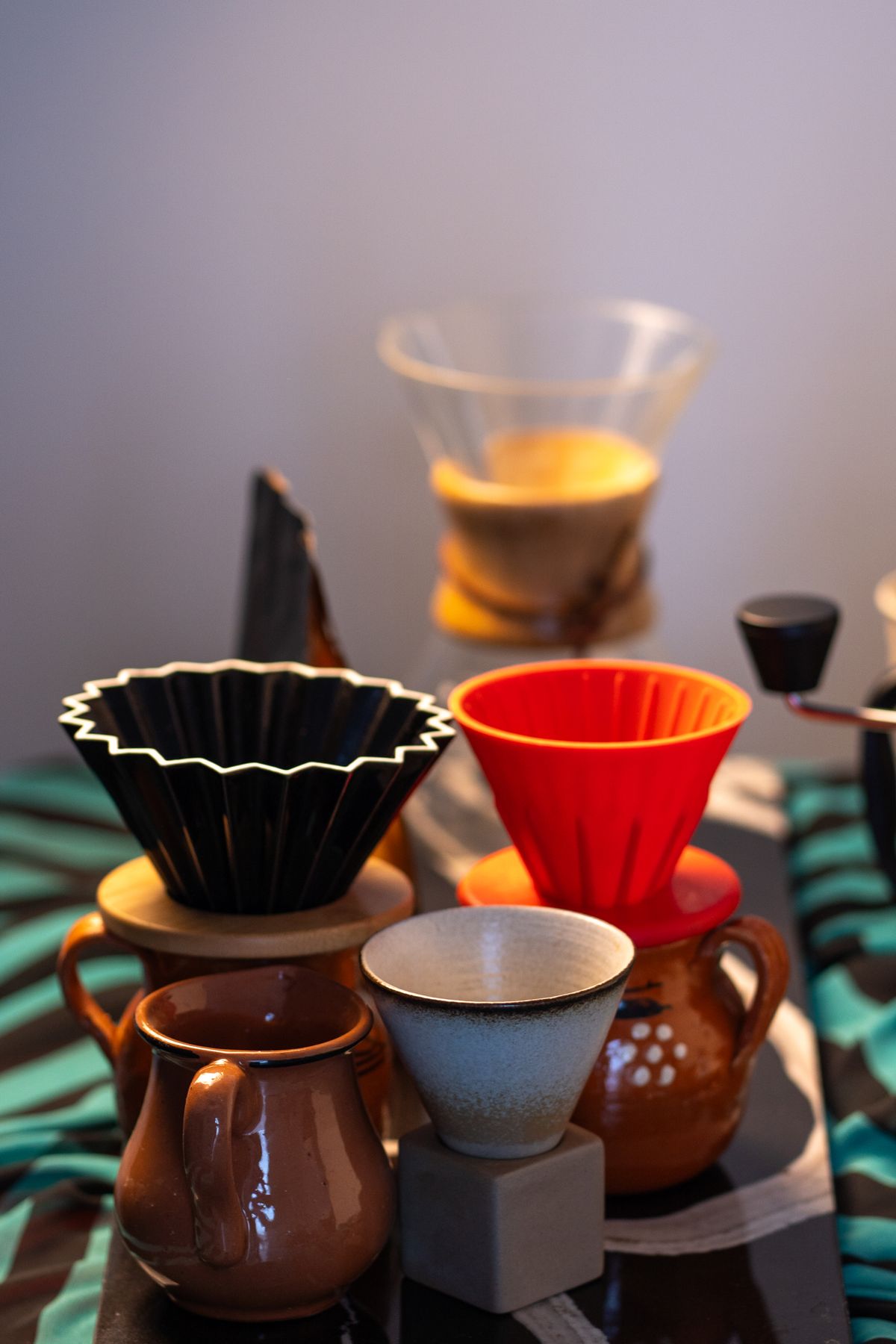
Image: Israyosoy S. via Pexels. For illustrative purposes only - not the exact products reviewed.
V60 vs. Chemex vs. AeroPress: Which Brewer Matches Your Morning Routine?
Three brewers come up every time someone asks what to buy first, and all three make good coffee. The difference is what they ask of you at 7 am, how much coffee they make in one go, and what they cost to keep running. The Chemex gives the cleanest cup but drains slowly. The V60 gives the most control but punishes sloppy technique. The AeroPress is fast, forgiving, and makes one strong cup at a time. Here is the straight comparison, so you can match the brewer to your morning instead of to someone else's favourite.
What this comparison is based on
Nothing here has been bench-tested by us. No one at Pour & Calibrate has run all three brewers side by side on a bench for this article. What follows is desk research: published specifications, manufacturer documentation, and widely reported user experience. Where the evidence is soft, we say so. Where research suggests a difference, for example in how filter thickness affects what ends up in the cup, we phrase it that way rather than as a fact we proved. There are no paid rankings here, no star ratings, and no outcome promises. Prices move around, so treat the figures as a rough guide rather than a quote.
What all three have in common
Before the differences, the shared ground, because it matters more than the choice between them. All three brew with paper filtration, so all three reward fresh beans ground just before brewing. All three are happier with a burr grinder than with pre-ground coffee, and all three respond to the same basic controls: grind size, water temperature, dose, and pour. Water just off the boil works for every one of them, and a ratio somewhere around 1:16 (roughly 60 g of coffee per litre of water) is a sensible starting point for the two pour-overs. The AeroPress has its own recipes and its own ratios, but the same variables drive the cup. If your water tastes of chlorine, so will the coffee from all three, and filtered water fixes that before any brewer upgrade does.
Cup clarity: what the filter lets through
This is the biggest real difference between the three, and it comes down to the filter more than the brewer body.
Chemex, cleanest. The Chemex uses bonded paper filters that are noticeably thicker than standard pour-over papers. Most of the coffee oils and nearly all the fine particles stay in the filter rather than in the cup. What gets through lands clean, transparent, and tea-like. If you drink light roasts and want to taste what the roaster was doing, this is the most revealing of the three. The flip side: if you are used to a French press, the Chemex can read as thin or empty, especially at a weak ratio.
V60, crisp but technique-dependent. The V60 takes a standard-thickness cone filter, so more body and aroma survive than with the Chemex. The good cup is crisp, sweet, and detailed. It is also the least forgiving of the three: the gap between a sweet cup and a sour one is a couple of grinder clicks or one careless pour. Get it right and many people think it is the best of the three. Get it wrong and it is the worst. Our pour-over troubleshooting guide covers the fixes when a V60 cup turns sharp or bitter.
AeroPress, full-bodied and forgiving. The AeroPress steeps the grounds as immersion and then presses the brew through a small paper micro-filter. The result is fuller-bodied than either pour-over, with less of the transparent clarity the Chemex gives you, and it is far less sensitive to how you pour. One honest caveat: none of these brewers can rescue stale beans or a bad grinder. Grind quality moves the cup more than the brewer does, and our grinder guide explains what actually matters there.
Workflow and speed
AeroPress, fastest. Heat water, add grounds, pour, stir, wait about a minute, press. Most published recipes land around two minutes end to end, and the process barely changes whether you are half awake or fully caffeinated. There is no pouring technique to practise and no bed to keep level.
V60, hands-on the whole time. A V60 wants a gooseneck kettle, a scale, and your attention. A bloom, then two or three controlled pours, watching the bed the whole way. Realistic total time is around three to five minutes, and almost all of it is active. It is a ritual you do rather than a thing that happens while you do something else.
Chemex, slowest drain. The thick filters restrict the flow, so the brew drains slowly even when your grind is right. Expect roughly four to six minutes in the cone alone, plus pre-heating if you care about temperature. You can walk away briefly between pours, but this is the least compatible with a hard deadline. On the plus side, the brew is close to self-running once the water is in: there is no pressing stage and no second vessel to deal with.
Serving size: how much each one makes
The serving question settles a lot of arguments before taste even enters it.
- Chemex Classic 6-Cup: two to three mugs of normal size (around 12 oz / 350 ml each). This is the one to buy if two or three people drink at once, and the glass carafe goes to the table.
- V60 Size 02: one generous mug, or two small cups if you stretch the ratio. It is a single-serve brewer in practice. Brewing twice in a row is normal in a household of two.
- AeroPress: one strong cup at a time. It brews a concentrate that many people dilute with hot water to mug size (around 8 to 12 oz / 240 to 350 ml). Serving a table means pressing once per person.
Learning curve
AeroPress, easiest. The standard recipe works on day one. Because the brew is immersion, small errors in pour rate or grind setting move the cup less than they do with a pour-over. It is the sensible first brewer if your goal is a good cup tomorrow morning rather than a hobby.
Chemex, middle. The recipe is simple, and the slow drain forgives small pouring mistakes. What it does demand is a gooseneck kettle, some patience with the drawdown, and a feel for how fast you should pour. If you already know the basics from a first pour-over guide, the Chemex will feel comfortable within a week.
V60, steepest. Grind size, water temperature, pour rate, bloom time, and pour pattern all reach the cup directly. That is the appeal if you enjoy tuning things. It is friction if you just want coffee. Expect a stretch of mixed results while you dial in, then a brewer that rewards everything you learn.
Cleanup
AeroPress, easiest. Press the plunger, pop the puck into the bin, rinse the chamber and seal. Thirty seconds, no brush, no soaking.
V60, easy. The paper peels off the puck cleanly and the cone rinses in a second. Ceramic versions show coffee oils over time and benefit from an occasional wash with detergent, but daily cleanup is trivial.
Chemex, fussy. The wet filter is heavy and tears if you drag it out carelessly, and the narrow neck makes reaching inside awkward. A bottle brush earns its keep here. The glass carafe also shows stains and chips if you knock it against a tap. Not hard work, but the most work of the three.
- Weigh the coffee and the water every time. A scale beats scoops, whatever you buy.
- Starting cheap and rinsing it with hot water first: the Hario V60 Plastic Coffee Dripper, Size 02.
- Pre-heat it longer than you think, then brew: the Hario V60 Ceramic Coffee Dripper, Size 02.
- Pour slowly and let the cone drain at its own pace: the Chemex Pour-Over Glass Coffeemaker, Classic 6-Cup.
- Learn one recipe first, then change exactly one variable per brew: the AeroPress Original Coffee Press.
- Rinse every paper filter before it touches coffee: the Hario V60 Paper Coffee Filter, Size 02, 200ct.
- Fold it properly or it will not seat in the cone: the Chemex Bonded Coffee Filter, Unfolded Squares.
- One filter per press, barely dampened: the AeroPress White Paper Micro-Filters, 350ct.
Cost over time: the filter is the subscription
The brewer is a one-off purchase. Filters are the part you keep buying, and the three systems do not cost the same to run.
On the brewers themselves: the AeroPress Original Coffee Press is about $39.95, and the Chemex Pour-Over Glass Coffeemaker, Classic 6-Cup is about $47.03, the most expensive of the three. V60 pricing depends on the material, which we cover below.
On filters, the Hario V60 Paper Coffee Filter, Size 02, 200ct is about $13.20 for a 200-count box, the Chemex Bonded Coffee Filter, Unfolded Squares is about $19.49 per box, and the AeroPress White Paper Micro-Filters, 350ct is about $9.94 for 350 filters. Per filter, the AeroPress media are the cheapest and the Chemex papers the most expensive, and the Chemex uses the most paper per brew by a wide margin. Over a year of daily brewing none of this is ruinous, but if you are choosing on running cost, the Chemex asks for the most and the AeroPress the least. Filter prices also shift with subscriptions and multipacks, so re-check the per-filter cost before you commit to a system. If the whole setup budget matters more than the filter maths, our setup under $100 guide shows where the money actually improves the cup.
Travel and small kitchens
AeroPress, clear winner. It is light plastic, it survives being thrown in a bag, and it needs nothing but hot water and a mug. There is a reason it turns up in office drawers, campsites, and hotel rooms. If travel is part of your routine, this is the answer and the rest of this comparison barely matters.
V60, second. The plastic V60 packs flat and takes up almost no space, though you still need a kettle with a decent spout and something to pour into. We keep a full packing list in our travel pour-over kit guide.
Chemex, last. It is a piece of glassware with a wooden collar and a leather tie. It is lovely at home and a liability in luggage. Small kitchens also have to live with the fact that a six-cup Chemex is the tallest thing on the shelf.
Ceramic or plastic V60?
This is the one hardware decision inside the V60 choice, and the honest answer is not the flattering one.
The Hario V60 Plastic Coffee Dripper, Size 02 is about $12.13, weighs almost nothing, and will not shatter if you knock it into the sink. The important part is thermal: widely reported comparisons suggest the plastic version loses less heat during the brew than ceramic does, because it does not soak up energy the way a thick ceramic wall does. Rinse it with hot water first and the plastic V60 is arguably the more consistent brewer.
The Hario V60 Ceramic Coffee Dripper, Size 02 is about $27.08 and it is the nicer object. It feels solid, it looks at home on a counter, and it does not scratch or stain. The trade-off is that it needs serious pre-heating to stop it robbing heat from the slurry, and it can chip or crack like any ceramic. If the brewer lives on the counter and you care how the kitchen looks, the ceramic earns the premium. If you care only about what is in the mug, the plastic is the better value and, on the thermal evidence available, the steadier performer.
Honest verdicts by morning routine
There is no single winner here, because mornings are not the same problem in every household. Match the brewer to the routine you actually have.
If you are the rushed parent: the AeroPress, and it is not close. Two minutes, no pouring technique to get wrong before your first coffee of the day, one strong cup that can be diluted to whatever size your mug is, and cleanup measured in seconds. Pair it with pre-ground coffee on the worst mornings and you will still drink better coffee than most cafés sell, without adding stress before the school run.
If you are the slow weekend ritualist: the Chemex. It makes two to three mugs in one brew, the process is unhurried enough to feel like a ritual rather than a chore, and the clean, transparent cup is the one you sit with rather than glug. It is the best brewer of the three for a shared pot at the table and the worst one for a Monday at 7:05, and buying it means accepting exactly that.
If you are the tinkerer: the V60, plastic first. It is the brewer with the most variables to chase, the most direct feedback about what you changed, and the biggest gap between your best cup and your worst. That is a feature if dialling things in is the fun part and a bug if it is not. Start with the cheap version, learn to read the cup, and upgrade to ceramic later if you still love the process after a few months.
Whatever you pick, the boring parts decide more than the brewer does: fresh beans with a roast date, a grinder that produces even particles, filtered water at the right temperature, and changing one variable at a time. The brewer is the part you can see. The grind is the part you taste.